
VaDRR: Your Startup's Biggest Enemy
Every risk you're worried about is one of four risks in disguise.
Think about Darth Vader. Not as a villain in a movie, but as a concept. He is always there. Always looming. The Rebellion can't ignore him, can't wish him away, can't pretend he doesn't exist. They have to manage that threat, continuously, with limited resources, while still trying to build something worth fighting for.
That's your situation as an early-stage founder. Your job is managing a seemingly endless supply of threats to the survival of your business. Yet, in reality, it isn't dozens of different threats.
In the earliest stages of a company, nearly every meaningful risk falls into four categories: validation, distribution, revenue, and runway.
Everything else is either downstream of these, a derivative of these, or something you shouldn't be worrying about yet.
I call this the VaDRR framework: Validation, Distribution, Revenue, Runway. And the name isn't an accident. These four risks are the villain breathing down your neck. Learn to manage them well enough and you'll survive long enough to win.
The One Idea That Changes Everything
Early-stage founders tend to treat all four risks as equally important, which means they spread their attention thin across everything and make decisive progress on nothing.
I used to do this. I'd optimize for feeling productive, working on whatever seemed most urgent or felt most achievable that day. Then I'd wonder why three months passed without real traction. I was busy. I just wasn't learning anything.
The better approach is to identify the single dominant risk at any given moment and align nearly all of your work around reducing it.
Dominant risk isn't what feels most urgent. Urgency is often manufactured by external pressure or internal anxiety. The dominant risk is the one that, if left unresolved, makes progress everywhere else meaningless.
Understanding this reframes how you spend your time. Instead of asking "what should I work on today?" you start asking "what uncertainty am I reducing today?"
In what follows, I'll walk through each of the four risks, what makes each one dangerous, and how to know when it's the one demanding your attention. At the end, I'll give you the weekly loop that turns this from theory into something you can run with.
Validation Risk: Are You Solving a Real Problem?
Validation risk is present when the problem you're solving isn't real, isn't painful enough, or isn't owned by the person you think it is.
Founders get this wrong constantly.
They talk to potential customers and hear positive signals. They see heads nodding. They collect compliments. Then they mistake that social warmth for evidence of a real problem. "That's cool" and "I would use this" feel encouraging. That is't evidence. That's politeness.
The Rebellion doesn't win by guessing. Before they ever attack the Death Star, they establish a network of spies. They gather intelligence. They confirm the threat is real before committing resources to fight it. That's reconnaissance. That's what validation actually looks like.
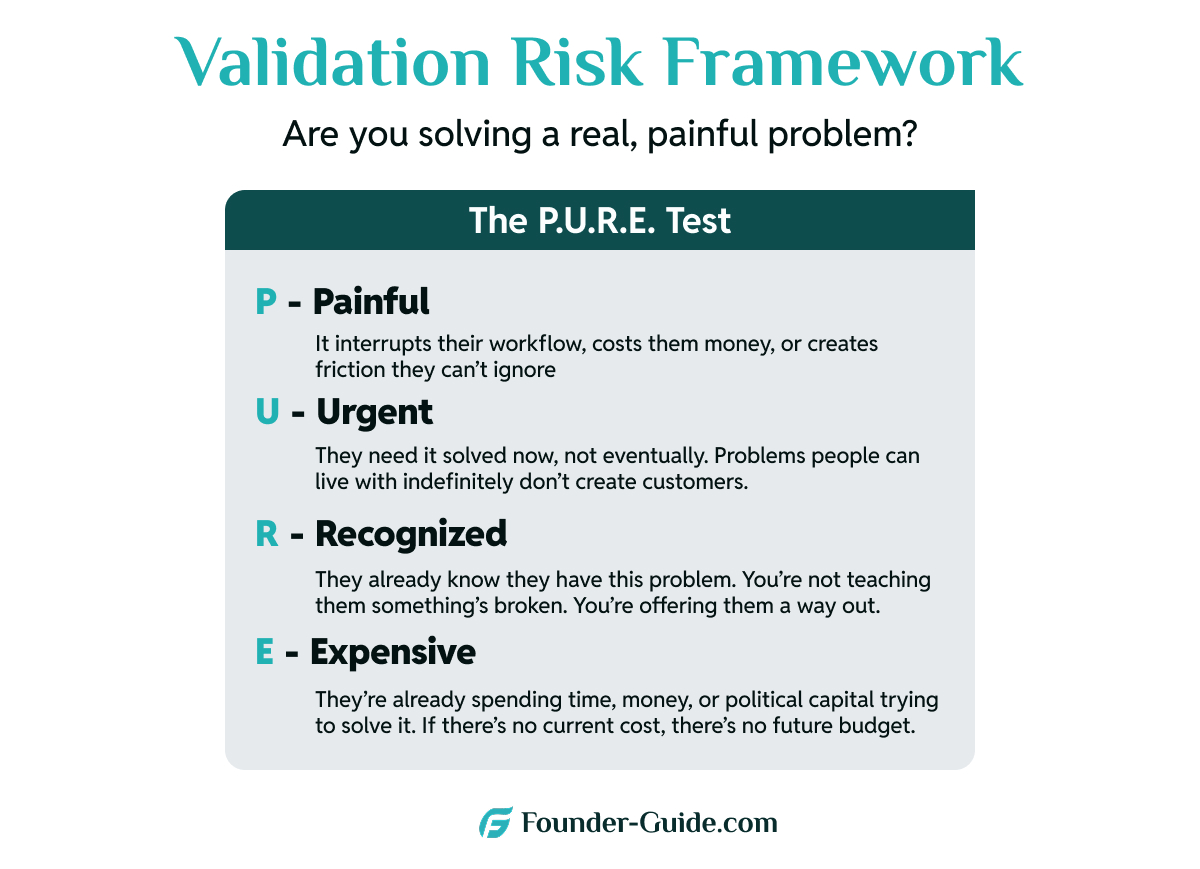
Real validation means the problem passes the P.U.R.E. test:
P - Painful: It interrupts their workflow, costs them money, or creates friction they can't ignore.
U - Urgent: They need it solved now, not eventually. Problems people can live with indefinitely don't create customers.
R - Recognized: They already know they have this problem. You're not teaching them something's broken. You're offering a way out.
E - Expensive: They're already spending time, money, or political capital trying to solve it. If there's no current cost, there's no future budget.
If the problem doesn't check all four, stop. You don't have validation. You have a nice-to-have wrapped in wishful thinking.
Lack of validation killed one of my startups. We interviewed sales reps and pre-sales consultants who all said the type of automation we were going to offer would be good. We took that politeness as validation, but six months later, no one was willing to pay. There was a problem to be solved, but it wasn't urgent or expensive enough to get people to buy.
Validation risk dominates until you have evidence the problem is worth solving. Otherwise, everything else is premature.
Distribution Risk: Can You Reach Them?
Distribution risk is present when you can't reliably reach people who could become customers.
Founders routinely underestimate this one because it doesn't show up until later. In the early days, you're focused on building something worth buying. Distribution feels like a problem for after launch. But this thinking is backwards. Distribution isn't something you solve after building. It's a constraint that should shape what you build and who you build it for.
The Rebel Alliance understands this instinctively. They can't build a competing Death Star. They don't have the resources. So they make a different strategic choice entirely: they build a network. Sympathizers on Imperial planets. Temporary bases. Spies feeding intelligence from inside the Empire. Each asset is small, but together they form something the Empire can't ignore.
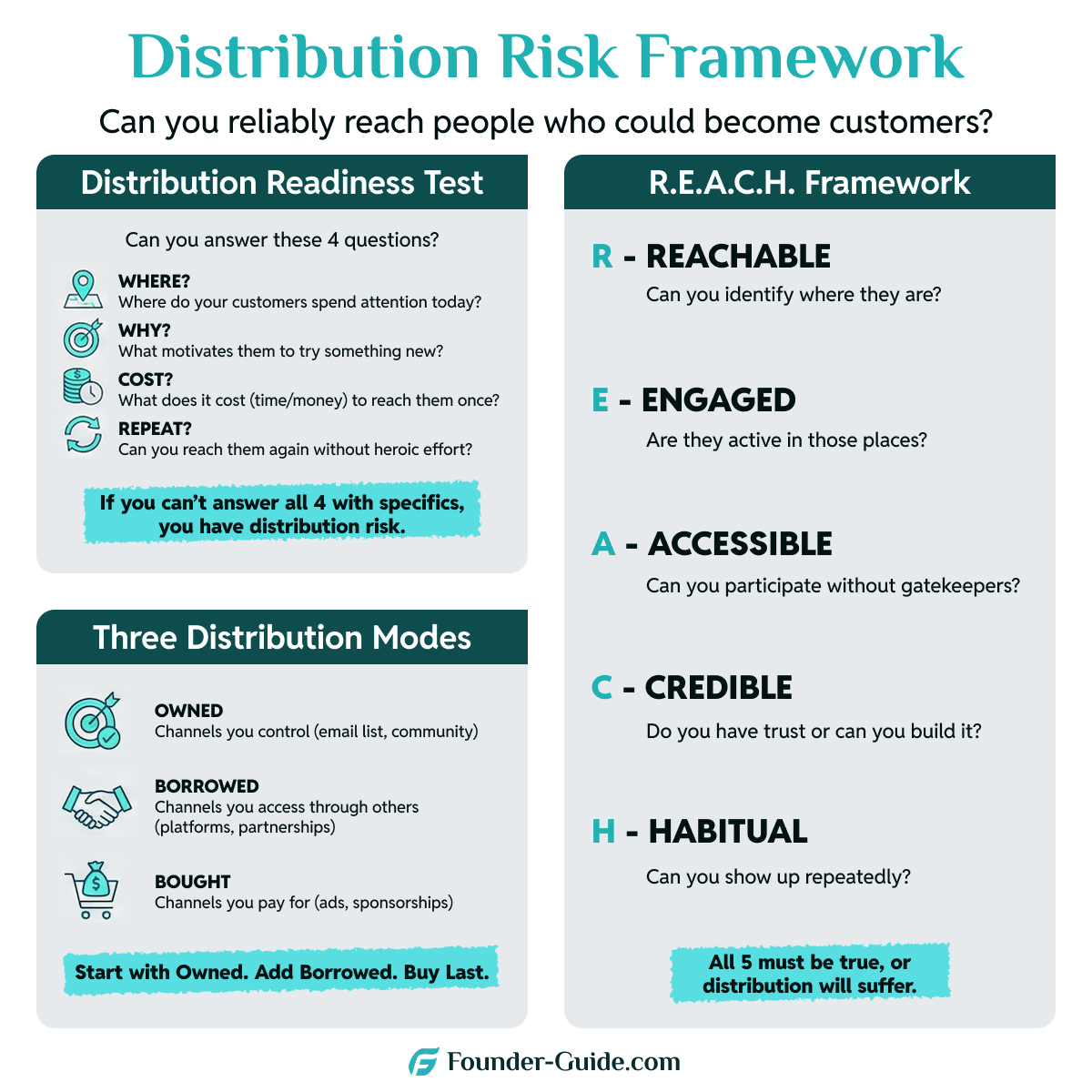
Building that network maps almost exactly onto the R.E.A.C.H. framework:
R - Reachable: You know where they spend time and attention. Not where you wish they were.
E - Engaged: They actively participate in their communities, not just lurk.
A - Accessible: You can reach them directly without gatekeepers.
C - Credible: You are trusted in that context. Credibility is built through repeated action, not a single message.
H - Habitual: You can show up repeatedly, not just once.
If you can't check all five, you don't have a distribution strategy. You have hope dressed up as a plan.
I talked to a founder who had initial success with referrals but now needed to expand his outreach. He complained that no one responds to email anymore, and he was asking for advice on a better way to reach potential customers. He should have been working on this before he was in critical need of it.
Distribution risk dominates when you know who would buy but can't consistently get in front of them. Your product is invisible by default. The founders who ignore distribution end up with something that works and a business that doesn't.
Revenue Risk: Does Value Convert Into Money?
Revenue risk is present when your solution's value doesn't translate into money in a repeatable way.
It's not just pricing. It's about whether the urgency of the problem matches the friction of the transaction. It's about whether the person who feels the pain has the authority to spend money to solve it. It's also about whether the sale can happen without heroic effort, every single time.
Founders avoid revenue risk because it's uncomfortable. Asking about money feels awkward. Hearing "no" feels personal so they optimize for softer signals instead. They track engagement. They celebrate usage. They collect testimonials. None of these are revenue. They might correlate with revenue eventually, but they're not the same thing.
Your customer is Han Solo. When the Rebel Alliance needs Han, they aren't asking a selfless hero to join the cause. Han is a smuggler. He believes in getting paid. He has his own priorities, his own risk tolerance, and exactly zero interest in saving the galaxy out of the goodness of his heart. Your customer has their own priorities. Their own budget. Their own reasons for saying no. Your job is to make the stakes clear, the urgency real, and the value obvious. They will talk themselves into it.
Two frameworks help here.
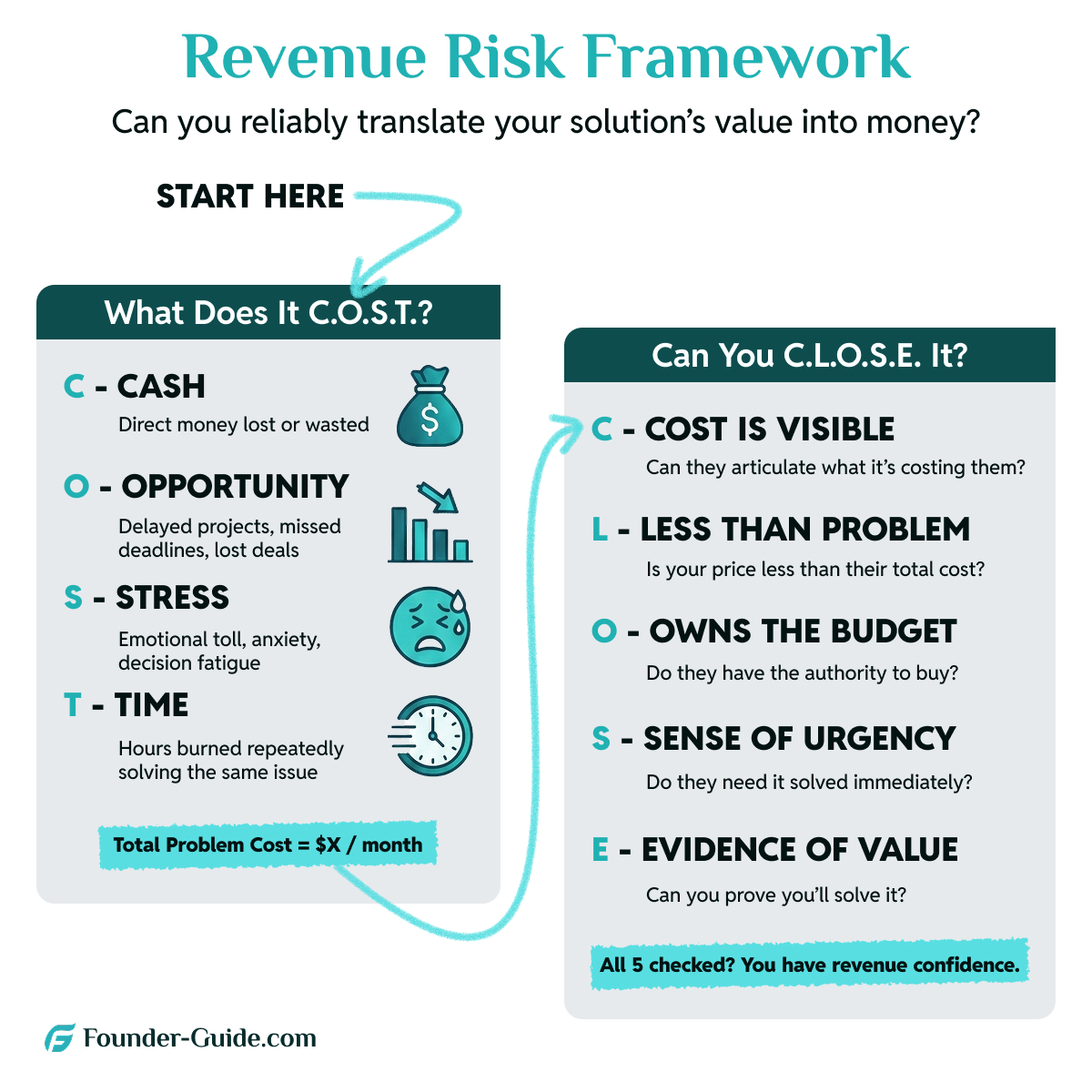
The C.O.S.T. framework reveals the problem's true cost. What is it costing them today?
C - Cash Spent: Direct money lost or wasted.
O - Opportunity Lost: Delayed projects, missed deadlines, lost deals.
S - Stress Experienced: Emotional toll, anxiety, decision fatigue.
T - Time Wasted: Hours burned repeatedly solving the same issue.
When you can name the total cost, pricing stops being a guess. You're not asking "how much would people pay for this?" You're answering "what is this problem already costing them right now?"
The C.L.O.S.E. test determines whether deals convert.
C - Cost is Visible: They can clearly articulate what it's costing them.
L - Less Than the Problem: Your price is meaningfully less than their total cost.
O - Owns the Budget: They have authority to spend or can access the means quickly.
S - Sense of Urgency: They need it solved now, not eventually.
E - Evidence of Value: You can prove you'll solve it.
If all five of these are true, the deal closes. If one is missing, you have revenue risk.
A founder with experience working at marketing agencies billing thousands to large corporate clients decided to start her own business. She had dozens of small business owners who actively wanted to work with her but they said her rates were way too high for them. She wasn't able to convert the opportunity into a customer at the rates the agencies got because the price was not less than the cost of the person's problem or the sense of urgency wasn't high enough.
Revenue risk dominates when people want the product but won't or can't pay for it in a scalable way.
Runway Risk: Do You Have Time to Learn?
Runway risk, running out of time, money, or energy before you can address the other three risks, is always present in early-stage startups.
The Rebellion has almost nothing. No massive budget. No army of highly trained clones. No guaranteed victory. What they have is enough fuel to keep flying, enough intelligence to make smart decisions, and enough discipline to not waste either one. The moment their fuel runs out, the fight is over. It doesn't matter how good their ships are or how smart their strategy is. No fuel, no fight.
Runway isn't just cash in the bank. It has three dimensions that burn simultaneously, often at different rates:
Financial runway: How many months until the money runs out?
Energy runway: How long can you sustain this level of intensity without burning out?
Time runway: How long until market conditions, personal circumstances, or opportunity costs force your hand?
You might have 18 months of cash but only 6 months of energy. Or 12 months of energy but a job offer that expires in 3 months. The cruel math is that all three burn together, but the one that runs out first is the one that ends things.
Runway risk is what makes the other three risks urgent. Without runway pressure, you could validate forever, test distribution endlessly, experiment with pricing indefinitely. Runway is the constraint that forces decision-making.
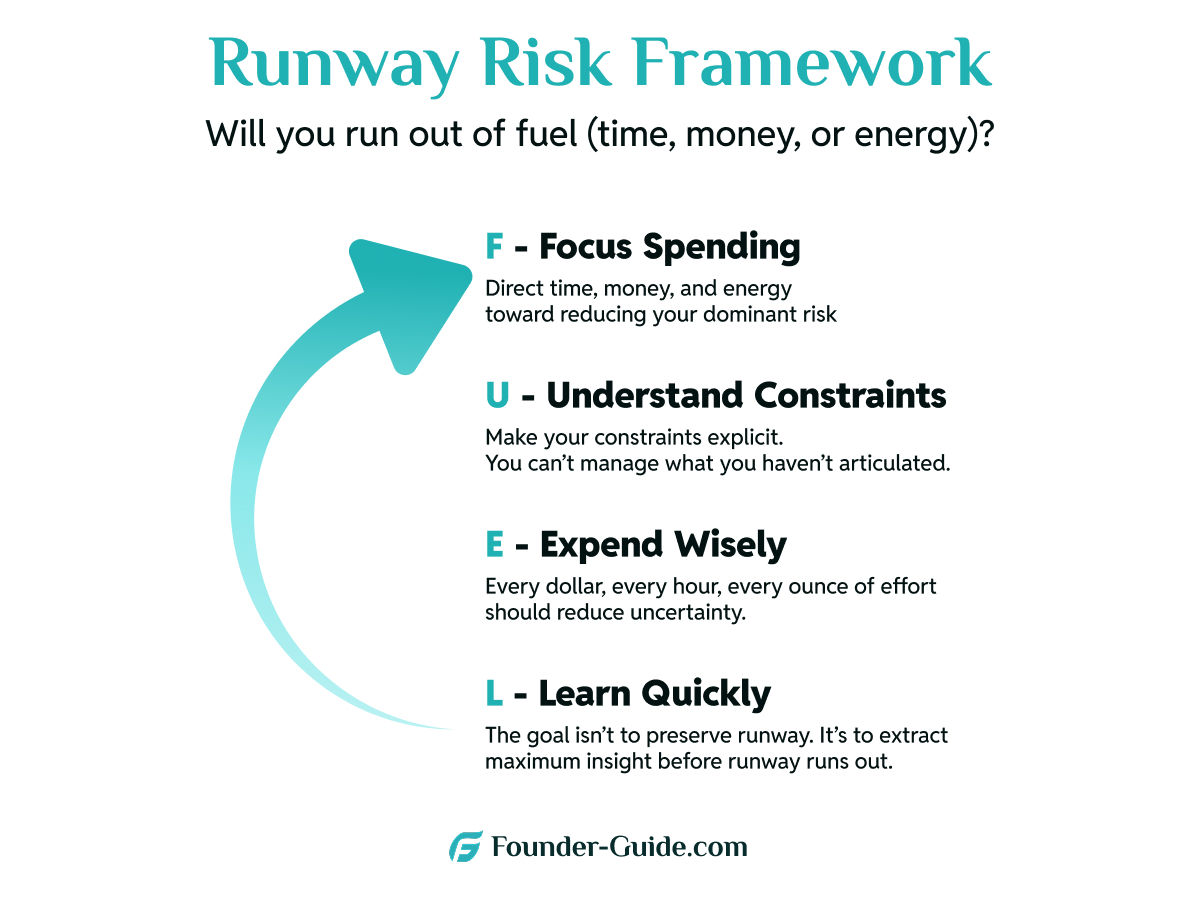
Managing runway requires F.U.E.L.
F - Focus Spending: Direct time, money, and energy toward reducing your dominant risk. Everything else is waste.
U - Understand Constraints: Make your constraints explicit. How much cash do you have? How long until a forcing function hits? What's the team's energy level? You can't manage what you haven't articulated.
E - Expend Wisely: Every dollar, every hour, every ounce of effort should reduce uncertainty. Don't waste resources on unvalidated assumptions.
L - Learn Quickly: The goal isn't to preserve runway. It's to extract maximum insight before runway runs out. The faster you learn, the more effective runway you have.
F.U.E.L. isn't a checklist. It's a cycle. Focus, understand, expend, learn. Then focus again with new knowledge. Every iteration makes you smarter. Every cycle extends your effective runway.
A founder was so stressed about scaling the business, he couldn't sleep and started developing health issues that prevented him from fully engaging with the business. Stress about scaling prevented the scaling. Cash runway existed. Energy runway did not.
Runway risk dominates whenever learning is slower than burn.
The Weekly Loop
This framework only works if you use it. Theory without a system is just something to read.
Here's the loop. It takes ten minutes at the start of your week and five at the end.
At the start of the week, ask yourself two questions.
- What is the dominant risk right now? Is it validation, distribution, revenue, or runway?
- What is the smallest action I can take this week that meaningfully reduces it?
That second question does most of the work. It forces you to be specific. "Validate my problem" is not an action. "Talk to three people who currently spend money solving this exact issue and ask what they're paying" is an action. The gap between those two statements is where most founders lose weeks.
During the week, say no to work that doesn't reduce that risk. Track evidence, not activity. If you can't point to something you learned, you didn't have a productive week. You just had a busy one.
At the end of the week, ask three questions.
- What did I learn?
- Did the dominant risk change?
- Am I more confident or less confident than I was seven days ago?
That last question matters more than people think. Confidence should be moving in one direction or the other. If it's flat, you're not learning fast enough. If it's dropping, pay attention to why. Both are information.
The founders who run this loop consistently tend to look like they're moving slower than their peers in the short term. They're not shipping as many features. They're not announcing as many updates. But three months in, they know more. They have confidence that's earned, not manufactured. They've either validated their way to something real or invalidated their way to a better direction. Either outcome is progress.
What Happens When the Loop Slips
The weekly loop works when you have mental clarity and emotional bandwidth. It falls apart when you're tired, when you're anxious, when everything feels urgent at once. This is where most founders need help. Not with understanding the framework, but with maintaining it when their brain is screaming at them to do literally anything else.
Founder Guide exists to make this loop easier to run, week after week, because you're human. It helps you identify and track your dominant risk explicitly, so the question at the start of each week has a clear answer rather than a guess. It captures validation, distribution, revenue, and runway evidence in one place, so you're not piecing together scattered notes at the end of the week. And it turns weekly reflection into structured decisions instead of vague intentions.
The core question Founder Guide forces you to confront is the same one this framework is built around: what risk am I reducing right now, and what evidence will tell me if it worked?
When it's impossible to always have the right answer, you may as well be honest about what you're trying to learn. Start at founder-guide.com.
The Fight That Matters
Darth Vader, like startup risk, is always looming. The VaDRR framework doesn't eliminate the risk. It gives you a system for managing the threat deliberately, week by week, before it manages you.
Every risk you're worried about is one of four risks in disguise. They're four angles on the same fundamental uncertainty: you don't know whether this business will work.
The Rebellion wins. Not because they're bigger, not because they're richer, but because they're smarter about what matters. They never stop asking the one question that counts: what is the biggest threat right now, and what can we do about it?
You have two possible outcomes here. You either build something real, or you find out fast that you shouldn't. Both outcomes are better than the alternative: staying busy while the answer hides from you in plain sight.
Founders who run this loop consistently are not just optimizing for survival. They're building something most founders never develop: the ability to see clearly when everything is uncertain. That perspective doesn't just help you with this startup. It changes how you approach every hard problem for the rest of your career.
The VaDRR framework gives you focus. The weekly loop gives you discipline. What you do with that power is entirely up to you. At least you know what you're fighting, and why it matters.